Register your interest today
Be the first to know when Amazon Leo is ready to deploy. Just fill out the form and we’ll be in touch.


Amazon Leo for enterprise offers ultra‑low latency, real‑time connectivity that your business can depend on, no matter where and how you operate.




Rely on flexible, scalable and secure connectivity.
Powered by AWS. Backed by Amazon.
UK Connect combines this high-performance LEO Satellite capability with our fully managed, enterprise-ready service.
Once ready to deploy, our experts will design, install, fine-tune and continually monitor your connectivity end-to-end, ensuring every location gets the speed and resilience your operations depend on - without adding pressure to your IT team.
Every site connected and managed for you
UK Connect install, activate, and optimise Amazon Leo end‑to‑end across all your sites.
Every technical detail is handled by in-house experts.

We verify Amazon Leo coverage for your sites and confirm technical suitability. Free, no obligation.

Our engineers specify the full architecture – hardware, integration with your existing infrastructure, failover logic and management plan.

Our in-house Field Technicians install and commission the hardware across your sites. We'll get you connected in days, not weeks.

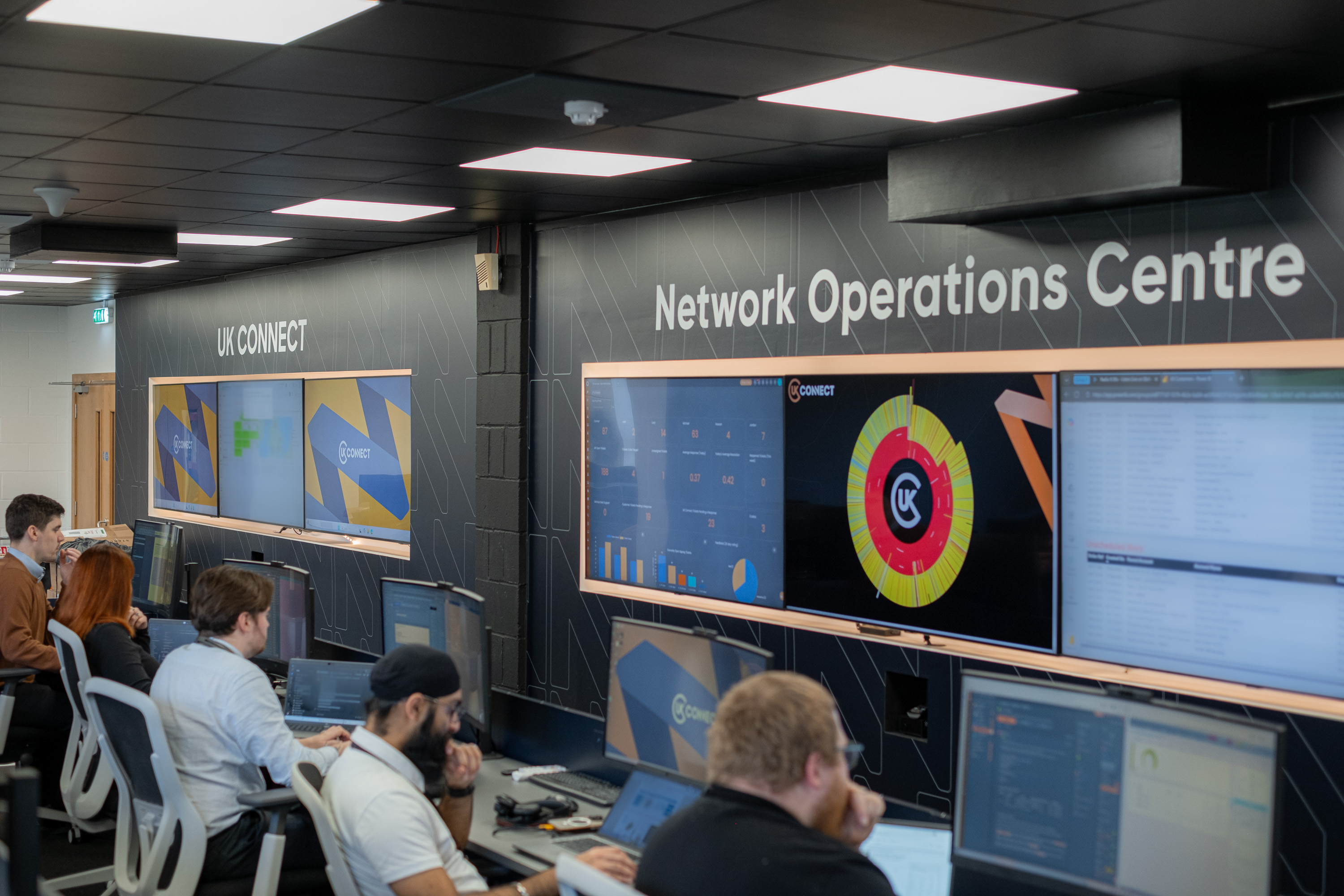
From day one, your network is monitored by our Farnborough Network Operations Centre – real engineers, not just automated alerts.

Regular performance reviews, firmware updates and configuration tuning as Amazon's Leo constellation continues to expand.
Be the first to know when Amazon Leo is ready to deploy. Just fill out the form and we’ll be in touch.
Once ready to deploy, Amazon Leo via UK Connect means you’ll be connected in days, not weeks.
Amazon’s Low Earth Orbit constellation will cover 100% of the UK – including areas that fibre and 5G will never economically reach. Rural and remote locations are no longer a problem!
UK Connect puts your entire connectivity estate under a single managed contract. You get one SLA, one invoice and one number to call.
Amazon have developed multiple antennas to give customers choice and flexibility: Nano, a 18 x 18cm model that delivers download speeds up to 100 Megabits Per Second (Mbps); Pro, a 28 x 28cm model that delivers download speeds up to 400 Mbps; and Leo Ultra, an enterprise-grade antenna that delivers download speeds up to 1 gigabit per second (Gbps) and upload speeds up to 400 Mbps.
Our in-house experts will ensure you get the fastest possible speeds through:
Organisations can create secure, private, high‑performance network links to AWS or their own data centres without using the public internet. Amazon focuses on two core offerings—Direct to AWS (D2A) and Private Network Interconnect (PNI)—with speed, security, and ease of deployment as the main benefits.
Reach out to us to find out more.
Professional installation is recommended, especially in complex environments. This is because:
Amazon Leo will deliver high bandwidth, low-latency connectivity using a global LEO satellite network. This makes it ideal for enterprises that need reliable, high-performance, day one internet in locations where fibre or 5G are unavailable, unreliable, or too costly to deploy.
Even if terrestrial networks fail due to mast works, construction, weather conditions, or outages, a satellite link remains active. This makes it valuable for:
Many enterprise locations such as mines, farms, offshore facilities, construction sites, and logistics hubs, operate far beyond the reach of dependable terrestrial networks. LEO Satellite connectivity overcomes this by providing rapid, infrastructure‑free deployment and delivering consistent, high‑performance connectivity regardless of geography.
Energy & Utilities — Oil, gas, wind, and grid operators rely on real‑time monitoring, safety systems, and remote workforce coordination in places where terrestrial networks don’t reach. LEO delivers low‑latency links for SCADA, IoT, and field operations.
Maritime & Offshore — Ships, rigs, and offshore platforms need always‑on connectivity for navigation, crew welfare, and operational data. LEO’s global coverage and fast response times outperform traditional GEO maritime links.
Agriculture — Modern farming depends on precision tools, sensors, drones, and automated machinery. LEO enables high‑bandwidth, low‑latency connectivity across vast rural areas where 4G/5G is patchy or absent.
Retail (Backup Connectivity) — Distributed retail sites can’t afford downtime at tills or payment systems. LEO provides resilient, plug‑and‑play failover connectivity that keeps stores trading even when fibre or broadband drops.
Logistics & Fleet Operations — Fleet tracking, telematics, and real‑time routing all benefit from LEO’s ability to maintain connectivity across motorways, rural routes, and cross‑border operations.
Construction — Temporary sites often lack fixed infrastructure. LEO gives contractors instant, high‑speed connectivity for site offices, digital workflows, CCTV, and machine telematics from day one.
Remote Healthcare – Telemedicine, diagnostics, and mobile clinics rely on stable, low‑latency links to specialists and patient records. LEO enables high‑quality video and data transfer even in isolated communities.
